google.com, pub-3680554235834172, DIRECT, f08c47fec0942fa0

gtag('config', 'UA-6115888-3');
No, not that. A journalist in her 20s. An interesting street interview by JD Lasica, touching on most of the social media sites and newspapers to some extent.
It seems odd that very little has been made of this so far. Perhaps when we reach the actual date, which is Jan. 30. But it was the last time the Beatles played live together, up on a rooftop in London 40 years ago. Those boys must have been cold. I suppose the adrenaline was warming them up.
This is not readily available on DVD. Most versions are out or going out of print and rather pricey. A definitive issue of Let It Be is supposedly in the pipeline although no firm release date has been given by Apple.
Enjoy.
Susan Tedeschi’s Back To The River, released late last year, quickly moved to the top of the Billboard Blues chart and remains near the top after nine weeks. But it appears to have been virtually ignored by most of the major rock magazines.
That’s too bad because as much as this is a blues outing, it’s a smokin’ rock ‘n roll record as well and another to add to the best of 2008. With the centerpiece Tedeschi’s blues drenched vocals, River is one of her best records and shows how she not only uses her considerable playing and singing abilities but also her strong collaborative songwriting skills.
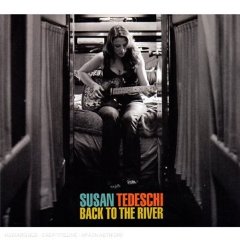 At first. Tedeschi’s voice is reminiscent of some great blues and rock singers of recent history such as Bonnie Raitt and Bonnie Bramlett, but the more you listen, the more you discover her unique approach, phrasing and a rough, sometimes raspy edge to a prodigious vocal range and quality that is rarely rivaled among female singers today.
She wrote the opening track, Talking About, with Doyle Bramhall II and husband Derek Trucks, both of whom have recently played in the Eric Clapton band, most notably at the 2007 Chicago Crossroads concert that included a set with Steve Winwood. Both are extraordinary slide players and the tune sets the tone for the album, which is infused with infectious riffs, gritty blues melodies and virtuoso playing throughout.
Trucks, who has his own band and also plays with the Allman Brothers, co-wrote two other tracks, including Butterfly, which is one of the more soul-flavored tunes with a riff and feel that reminds one a little of Sly Stone.
John Leventhal (two songs), Tony Joe White, Sonya Kitchell and Gary Louris are among the other co-writers. Can’t Sleep At Night is Tedeschi’s own and she covers Allain Toussaint’s There’s A Break In The Road.
Bramhall’s soloing and lead lines, which Tedeschi’s vocal doubles at times, over the burning groove of Talking About give way to the R&B ballad 700 Houses, showcasing a more tender side to Tedeschi’s voice, underscored by hopeful lyrics, Trucks’ melodic lines on slide and tasteful horns.
Tedeschi’s core band of guitarist Dave Yoke, keyboard player Matt Slocum, Ted Pecchio, bass, and drummer Tyler Greenwell lays down deep grooves as witnessed by the wah-wah driven title track. Tedeschi takes lead guitar outings on six of the tracks, including River, lending a nice contrast to the Bramhall-Trucks tandem with her clean Telecaster tone.
The album doesn’t have a weak track on it. From the strutting groove of Love Will to a soul-inflected People, the heartfelt Revolutionize Your Soul and the driving hidden/bonus track 99 Pounds, it clearly reinforces Tedeschi’s position as a premier singer, songwriter and player.
One of my picks for top albums of 2008 was Sunday At Devil Dirt by Isobel Campbell & Mark Lanegan, a beautiful mix of traditional and contemporary folk and country influences with a startling contrast in vocal styles.
Here is a site called live on 35mm that features black and white photos of live music by the photographer Valerio. This page is from a Campbell & Lanegan concert around Christmas time in England. Some nice images.
Whether newspapers die, that is. Well, I’m sure many of us would say yes. But maybe it’s not about how the news is delivered, but rather that we are concerned about journalism, the stories, the ones that matter. Will they die or fade away?
A couple of viewpoints:
One from a social media site. Are social media sites in competition with newspapers? Yeah, actually, I believe they are.
A nice resource for journalists learning about and making the transition into the new media era.
It came as a bit of surprise to see the release of 2 by Fotheringay last year. The group Sandy Denny, considered the greatest vocal interpreter of British traditional music, left Fairport Convention for with her lover/soon to be husband Trevor Lucas in 1970, recorded tracks for a second album but it was never released.
 In fact, it was doubtful there was enough there for a second album. The self-titled debut earlier in 1970 was a nice enough start but hadn’t exactly eclipsed the best of Fairport, which was to England what the Byrds were to America in its blending of rock, pop and traditional sensibilities.
Both Denny and Lucas have long passed, but the other members, guitarist Jerry Donahue, drummer Gerry Conway, who later played with Cat Stevens, and bassist Pat Donaldson regrouped last year to finish the project. This has been tried before, particularly in the Hendrix camp by previous estate supervisor Alan Douglas, with very mixed results. But from the opening bar of this album’s first track John The Gun, you immediately sense this is different and right.
The sound literally jumps from your speakers in clarity and presence, the playing is skilled and tasteful and the vocals, although taken from reference tracks recorded during the laydown of the basic tracks, are inspired and near flawless by Denny and Lucas.
The reason for the unfinished product in 1970 was Denny’s departure for a solo career, something her label, Island, had been lobbying for. Some of these tunes showed up on her first solo effort and others have been released on various box set retrospectives of her work. But none sound better than on this record.
The waltz time interpretation of Silver Threads & Golden Needles is a significant improvement over previously released versions. A traditional tune, Wild Mountain Thyme, also recorded by the Byrds and Van Morrison among others, lends itself beautifully to Denny’s pure voice streaming over the bass of Lucas’ harmony.
Late November, to appear later on Denny’s The Northstar Grassman & The Ravens, joins John The Gun as the only Denny-penned songs on the set. It’s a somber, moderate tempo, traditional sounding piece so familiar to her oeuvre.
Fotheringay try a second take on Gypsy Davey, a traditional that appeared on the self-titled album, and play a relaxed groove that features Denny smoothly doubling in the middle section with Donahue’s lead guitar. Dave Cousins’ Two Weeks Last Summer closes the album, a 12-string dominated folk tune reminiscent of the Byrds, which falls into Denny’s range perfectly.
One of the only regrets is that nearly half of the vocal leads are taken by Lucas, whose in fine form but can’t match his exquisite partner. His tracks are much more country oriented than tunes he sang on the first album and they indicate the direction he may have wanted to take the group.
Jerry Donahue was involved in a similar reconstruction project with a Denny concert, Gold Dust Live At The Royalty (1998), her last before a death attributed to a fall in 1978, on which he overdubbed various guitar parts during his production. That one was seamless. This one is even better. The exact additions or remakings of each track are not documented, but that the original members are the contributors should erase any doubts about the project or its intentions.
Money. This twittered on a tweet.
Peter Neri and I grew up in North Haven and played Little League together for Olsen Plumbers and Candid Cleaners. Later, we played in two bands that helped establish Connecticut’s rock ‘n roll scene in the late ’60s: the Bram Rigg Set, which has several tracks on the 2008 Sundazed Records compilation Don’t Press Your Luck; and Pulse, which released a self-titled album on a Buddah Records subsidiary, Poison Ring. It’s re-released every couple of years on a new label.
Both bands were managed and produced by Doc Cavalier out of Syncron Studios, later Trod Nossel. He also produced the Wildweeds and Fancy, one of Christine Olhman’s first bands, among many others.
Beau Segal, who later ran the Oakdale Theatre in Wallingford, was the drummer in both groups. Bob Schlosser, now Bob Lacey, a successful radio talk show host in North Carolina, was the singer in the Bram Rigg Set, and Rich Bednarczk played keyboards in both lineups. Jeff Potter, later in Clean Living and now with his own highly successful touring band out of Northhampton, Mass., played harp and percussion with Pulse. And Carl Augusto, then Carl Donnell the lead singer with Pulse, is now president and CEO of the American Foundation for the Blind.
OK, enough name-dropping. What I meant to say is:

Peter Neri has two outstanding acoustic guitar CDs he’s recorded in the past few years that you can check out at his web site: Night Visions, an eclectic mix of blues, folk, Americana, fingerstyle playing and other influences and Dreaming Of Home, an expressionistic take on parenting through his guitar playing, a dazzling mix of fireworks and feeling. On the second title he conveys so many emotions about raising kids just through his music, no words, an amazing achievement. They are available on CD or download with proceeds from Dreaming Of Home going to relief organizations and charities.
I”ll admit it, I’m biased, but it’s still beautiful music.
 While I’m at it, Christine, who has sung with the Saturday Night Live band for years, has just released a retrospective, Re-Hive, with her band Rebel Montez, which is still very active on the Connecticut circuit.
News and views about the media, particularly newspapers:
Some newspapers are considering publishing fewer times a week. I wonder if the state paper is considering this? It would seem the Monday paper would be a candidate for dispatching with the exception of the NFL.
My other big question is where is all the increased focus on local and regional news for The Courant. I just don’t see it yet. Do you?